01 / SOURCE FAMILY
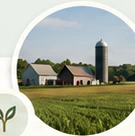
Farms
Manure, crop residues and food wastes.
Collection varies by season, material and farm operations.WHERE FUTURE PATHWAYS BEGIN LOCAL STREAMS · RELIABLE SUPPLY
Farms, breweries, sawmills, restaurants, food service, wood waste, industrial byproducts, municipal organics, and water-related residuals can each generate a modest stream. Central New York’s opportunity is to aggregate them into dependable supply—and support businesses dedicated to collection, aggregation, preparation and delivery.
Potential source families, not an inventory of committed suppliers or approved material uses.
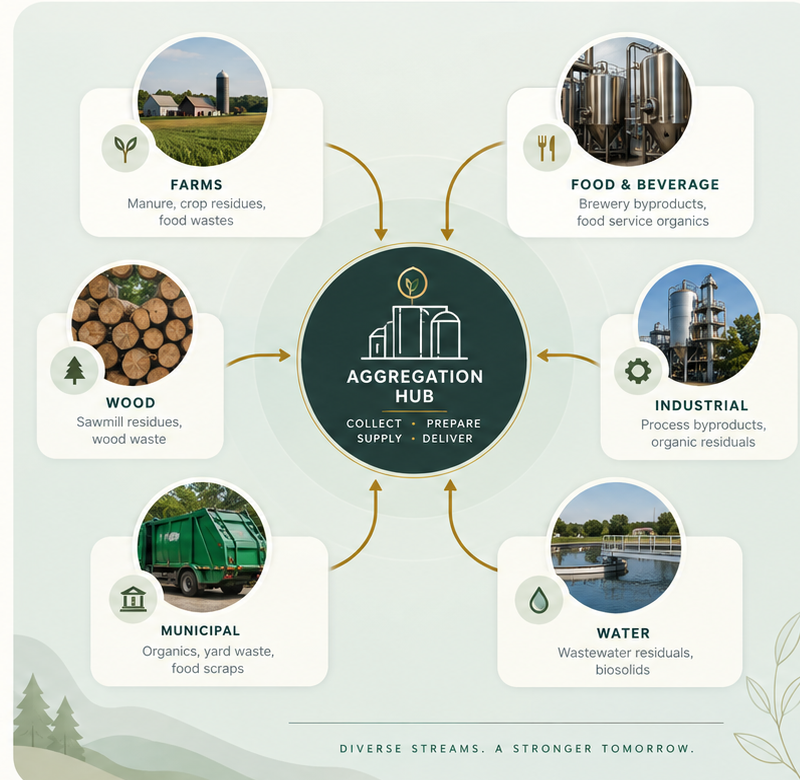
SIX POSSIBLE SOURCE FAMILIES
These are the categories from the approved V2 illustration. Each has different handling requirements, established outlets, technical constraints and commercial possibilities. They must not be mixed together simply because they share a circular-economy narrative.
Manure, crop residues and food wastes.
Collection varies by season, material and farm operations.Brewery byproducts and food-service organics.
Separate streams and confirm current higher-value outlets before diversion.Sawmill residues and wood waste.
Moisture, treatments and contamination determine suitable uses.Process byproducts and organic residuals.
Each process stream requires its own characterization and approvals.Organics, yard waste and food scraps.
Source separation, collection costs and contamination control matter.Wastewater residuals and biosolids.
Regulatory, pathogen, chemical and site-specific controls are essential.THE COMMERCIAL CONNECTION
The economic opportunity may be collection coordination, quality management and dependable delivery—not necessarily owning a processing plant. Start by finding existing businesses and available capacity.
Document owners, stream volume, timing and present disposition.
Keep the right streams separate and control pickup costs.
Combine compatible volumes without losing origin or quality records.
Sort, dry, condition or treat only as required by the chosen use.
Deliver at the needed specification and an economically viable price.
A regional supplier might specialize in source separation, regular pickup, short-term storage, screening, laboratory coordination or logistics. Capacity should be added only after actual source agreements, throughput and repeat demand support it.
Explore business & market roles ↗NO PREDETERMINED PRODUCT
The source comes first. Characterize it, protect valuable existing markets, then compare applications that can satisfy their distinct requirements. A weak loop should be rejected.
Some resource streams have existing beneficial or higher-value destinations. A new circular proposal must establish why changing the flow is better.
Different materials may suit different biological or thermal processing routes, subject to characterization, approvals, environmental results and buyers.
Potential soil amendments or recovered products require application-specific performance and contaminant controls; residuals are not interchangeable inputs.
THE EVIDENCE GATE
Use these screening questions before discussing investments. The list is a proposed decision framework, not an assertion that any CNY stream has passed the tests.
Each gate should make uncertainty smaller. The right result may be to keep an existing outlet, redesign the plan or stop.
Document who owns the material, how much exists, how variable it is and what presently happens to it.
Source records · seasonality · ownership and current destination
MAKE THE NEXT CONNECTION
Useful first contributions include source and volume information, current outlets, processor capabilities, buyer specifications, and practical transport or quality constraints. These inputs can help determine whether a candidate pathway deserves further study.
Who has the material? At what volume and consistency?
What use fits? Under which specifications and approvals?
Who will buy? At what reliable delivered cost?
What remains? A real regional capability, not just another facility.