 Oak OrchardWater supply · existing municipal asset
Shared industrial capability
Reclaimed water can become shared industrial infrastructure for Central New York.
Oak Orchard and Micron-related infrastructure are expanding the region’s ability to treat, reclaim and reuse industrial water. That creates shared value across multiple industrial users.
Opportunity, not an operating-system claim. This approved reference is conceptual. Existing infrastructure, proposed investments and future shared uses are distinguished below; the hero's project-status wording is pending technical verification.
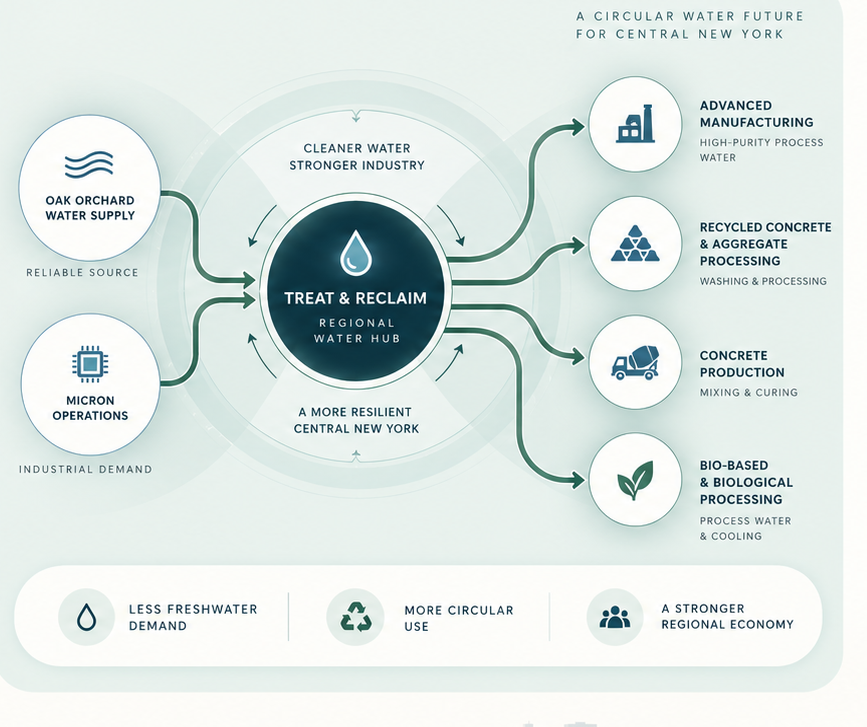
A circular water future · Central New York
Oak OrchardWater supply · existing municipal asset Micron operationsIndustrial demand · proposed / to qualify
Regional water hub · conceptual
Treat & reclaim
Source quality · treatment · reliability
Candidate industrial uses · subject to qualification
 Advanced manufacturingHigh-purity process water
 Recycled concrete + aggregateWashing and processing
 Concrete productionMixing and curing
 Bio-based processingProcess water and cooling
♧ Less freshwater demand↻ More circular use◉ A stronger regional economy
View the full approved water infographic
A stronger region
Shared resources attract investment and good jobs.
Greater efficiency
Maximizes water use through reuse and circular systems.
Multiple users
One infrastructure platform. Broad, lasting value.
Start with what is real
Existing assets.
New possibilities.
Water reuse is a potential extension of existing regional capacity—not a claim that all proposed plants, distribution networks or customers are already in place.
Oak Orchard WWTP
An established municipal wastewater-treatment facility serving the region. It is the existing asset in the conversation, not evidence that every industrial exchange is operational.
Treatment investments
Municipal upgrades and industrial water-treatment proposals are distinct workstreams. Their scope, delivery status, permits and interconnections require confirmation.
Broader shared uses
Industrial applications beyond committed users are candidates, contingent on specific quality standards, infrastructure, contracting and economic fit.
The regional water system
Different sources. The right treatment. A defined use.
Industrial reuse is an engineered service relationship, not simply redirecting a discharge. Quality, quantity, reliability, controls and responsibility must fit the specific user.
DECISION LOGIC · NOT AN AS-BUILT OR APPROVED DISTRIBUTION PLAN Sources Qualified pathways
Municipal wastewater
Sanitary flows served by an existing treatment system, with additional capacity or upgrades evaluated separately.
Existing service · proposed improvementsIndustrial process wastewater
Industrial streams need characterization and a treatment approach suited to actual composition and operating conditions.
Distinct treatment requirements◇
TREATMENT + ASSURANCE
03Meet the receiving use's requirements.
Demonstrate treatment performance, monitoring, storage, delivery and reliability for each application. Do not presume streams can be substituted for one another.
Industrial reuse
Only where fit-for-purpose quality, operating requirements, controls and supply arrangements can be verified.
Potential beneficial use · depends on proofPermitted discharge
Treated discharge and residual management remain subject to permits, oversight and environmental protection.
Not every flow belongs in reuseIllustrative decision framework; does not establish plant capacity, actual pipe routing, water entitlement, treatment approval or a customer agreement.
Where water could work again
Match the water to the job.
Applications have different water-quality envelopes and service requirements. Select an example to see its potential use and the evidence needed to qualify it.
Concepts · not committed demand
WATER RESOURCE · APPLICATION 01Qualified source→Fit-for-use treatment→Verified use
01 · Potential industrial demand
Cooling and utility systems
Cooling systems may offer repeat demand for fit-for-purpose reclaimed water when chemical compatibility, biological control, reliability and backup supply can be demonstrated.
What has to be demonstrated?
See the qualification gates Required water quality, cycles of concentration, corrosion and scaling control, seasonality and operational continuity.
Existing plants come first
Assess whether established operators and facilities can provide a service before proposing new shared assets.
Right-sized infrastructure
Shared treatment, pipelines and storage make sense only when credible users justify their added complexity.
Reusable operating capability
Sampling, treatment skills, maintenance and contracting know-how can support future customers.
REGIONAL ASSET
CENTRAL NEW YORK · WATER INFRASTRUCTUREOak Orchard
Existing municipal wastewater-treatment infrastructure
Build on what is already underway
A regional infrastructure story starts at Oak Orchard.
Oak Orchard is an existing wastewater-treatment facility. Planned municipal improvements and proposed industrial investments create a reason to evaluate water-reclamation capability without assuming they are one integrated, operating project.
The circular-economy question is whether qualified water reuse can connect dependable supply to credible regional users, with a defined service operator, appropriate treatment and verified delivered economics.
Explore the qualification requirementsFrom concept to service
Qualify the water. Prove the demand. Then build what earns its place.
The diagram is the opportunity, not its proof. Before implementation, the source, customer, infrastructure and commercial arrangement need to pass defined gates.
Characterize the source
Quantify availability, variability, contamination, seasonal swings and monitoring obligations.
Confirm the receiving use
Obtain explicit customer specifications for quality, continuity, peak demand and reliability.
Design a permitted service
Verify treatment, storage, conveyance, discharge conditions, permits, and operator responsibilities.
Demonstrate viable economics
Compare avoided freshwater costs, treatment energy, capital, conveyance, tariffs, risk and contracting.
THE INVESTMENT RULE
Start with existing capacity and committed demand. Add shared infrastructure only when multiple credible users, regulatory requirements and lifecycle economics support it.
The compounding regional advantage
Water reuse can create more ways to work.
↗
Local businesses
Monitoring, laboratory services, engineering, construction, equipment supply, controls, treatment operations and maintenance.
◎
Technical and trade pathways
Operators, water-quality technicians, pipefitters, electricians, mechanics, instrumentation specialists and supervisors.
∞
Knowledge that compounds
A proven operator network and reusable skills can support additional qualified industrial customers over time.
These are potential work categories, not a forecast of job numbers or a commitment to create specific positions.
Help shape what comes next
Where could qualified water create the next CNY opportunity?
Regional water providers, plant operators, manufacturers, materials processors, engineering teams and workforce partners can help identify real sources, uses and delivery constraints.
Explore water in the opportunity portfolio
Direct participation intake is not yet enabled. Do not submit confidential or regulated facility data through this draft site.
Bring what you know.
Prepare an outline about local materials, skills, demand or practical constraints. Nothing is submitted or stored by the preparation page; a receiving organization and official intake channel have not yet been established.
Prepare a contribution