Demand creates a reason to act.
Major public and private construction can create markets for qualified materials and services—subject to real specifications and procurement decisions.
WHY CENTRAL NEW YORK PEOPLE · PLACES · POSSIBILITIES
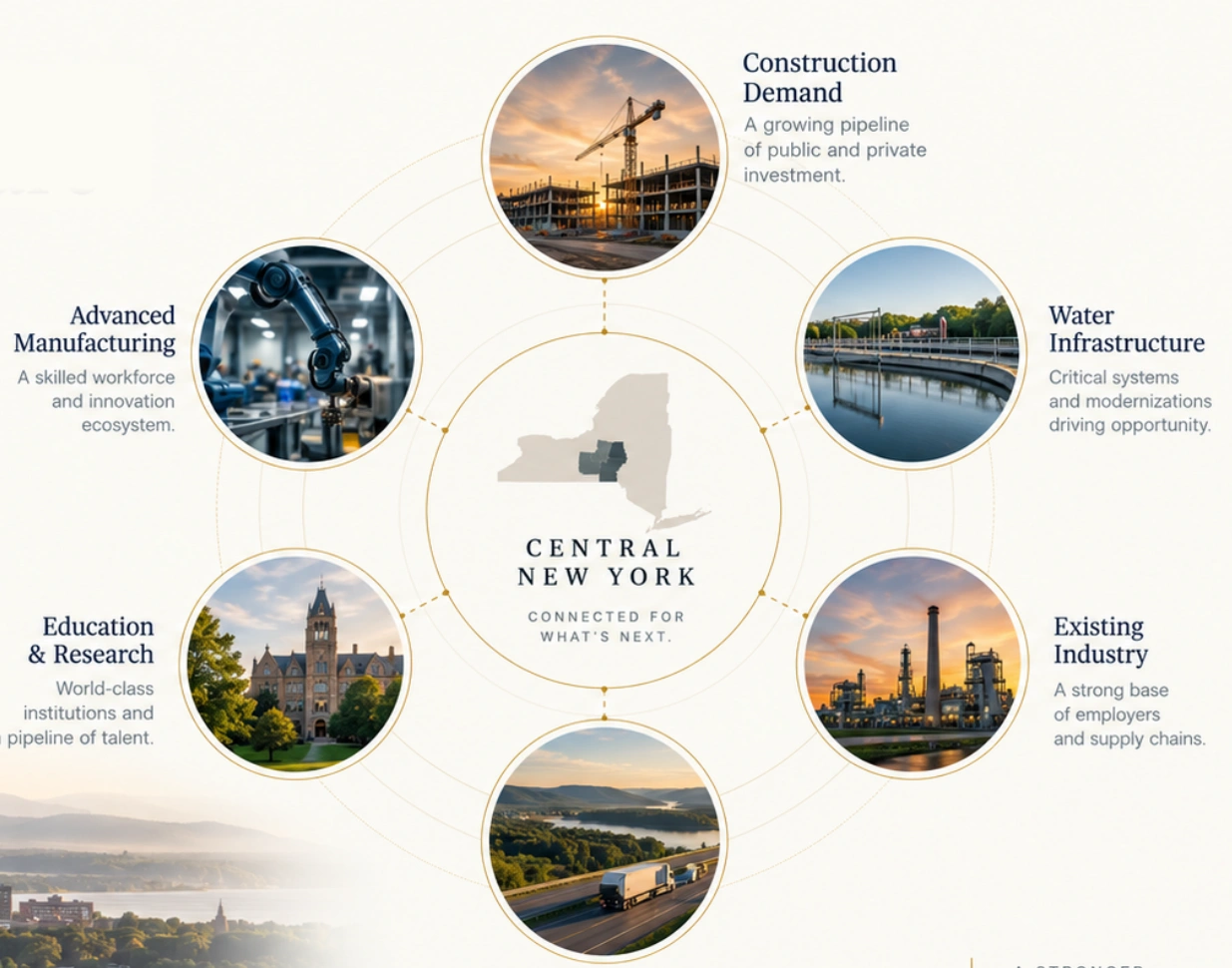
Central New York is compelling because several systems are moving at the same time: construction demand, advanced manufacturing, water infrastructure, existing industry, technical institutions and regional resource flows.
The diagram describes regional strengths and possibilities; it is not a claim that every interconnection is already operating or contracted.
ONE REGION · SEVERAL FORCES
The case for CNY does not rest on a single industry or facility. It rests on the potential to turn overlapping investment, resource streams and technical expertise into reusable regional capability.
Major public and private construction can create markets for qualified materials and services—subject to real specifications and procurement decisions.
Firms, utilities, laboratories and educators offer skills and systems that new opportunities may be able to build upon.
Testing, logistics, quality management and supplier relationships can remain useful after an initial project ends.
THE SIX REGIONAL INGREDIENTS
The six domains come directly from the approved V2 composition. Their roles are complementary, but specific project connections still need to be demonstrated.

A growing pipeline of public and private investment can create opportunities for qualified products, capable contractors and services.
Market access depends on specifications, timing and procurement.
Regional treatment systems and proposed modernization create questions worth testing about safe, fit-for-purpose industrial reuse.
New uses require separate treatment, approvals and commercial proof.
Operating companies bring equipment, experience and supply relationships that may be more valuable to adapt than replace.
Start with credible operators and customers.
Specialized production and a skilled workforce can create demand for precise quality, reliable supply and technical services.
Do not assume all industrial byproducts are reusable.
Universities, laboratories and training organizations can help characterize materials, prove applications and grow skills.
Independent qualification makes opportunity credible.
Regional transportation, material handling and distribution determine which supply networks are practical at delivered cost.
Distance, volume and reliability must work together.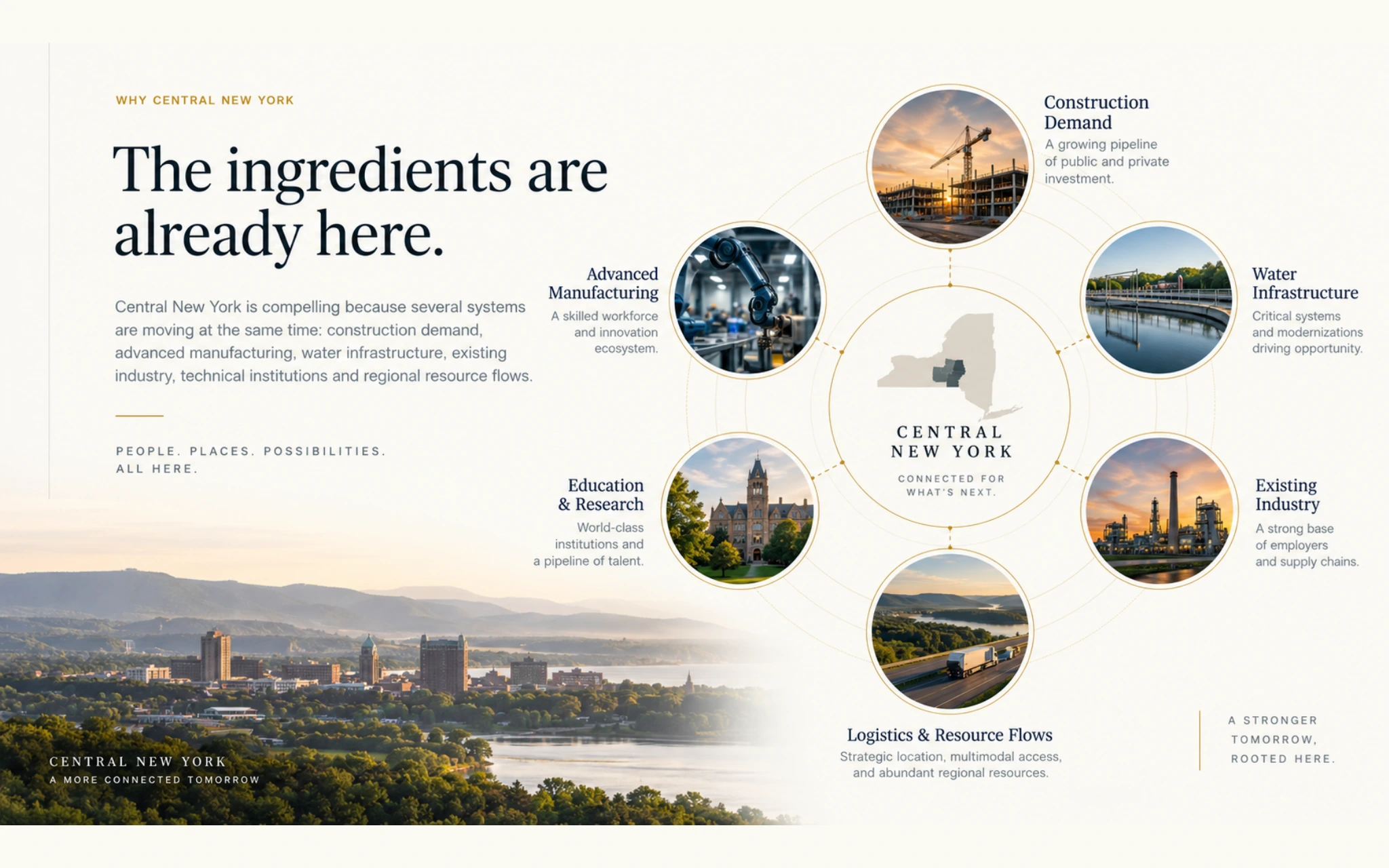
THE SECOND DIVIDEND
When qualification methods, trained people, suppliers and facilities can serve more than one credible customer, investment can compound rather than end with construction.

Testing methods, technical services and quality practices transfer to the next application.
Work with established businesses first; add shared assets only when credible demand warrants them.
New buyers and product pathways can open additional roles for suppliers, trades and skilled workers.
FROM REGIONAL ADVANTAGE TO REAL RESULTS
Regional readiness is a hypothesis to test against actual sources, users, standards and economics. The following questions are proposed screens, not completed validations.
Document where a material or service comes from, its real quantity, variability and current destination before designing a new supply chain.
Prefer validated regional capability and real buyers over speculative construction. New infrastructure should follow a demonstrable gap and repeat demand.