01
DISCOVERStart with real local resources.
Identify dependable material or water streams, existing firms, industrial demand and current alternatives.
NATIONAL POSSIBILITY A REUSABLE REGIONAL METHOD
Central New York can become a practical reference point for connecting local resources, industrial demand, shared infrastructure and investment.
This is a national adaptation concept—not a claim of active interregional agreements, operating routes, funded projects or proven economic outcomes.
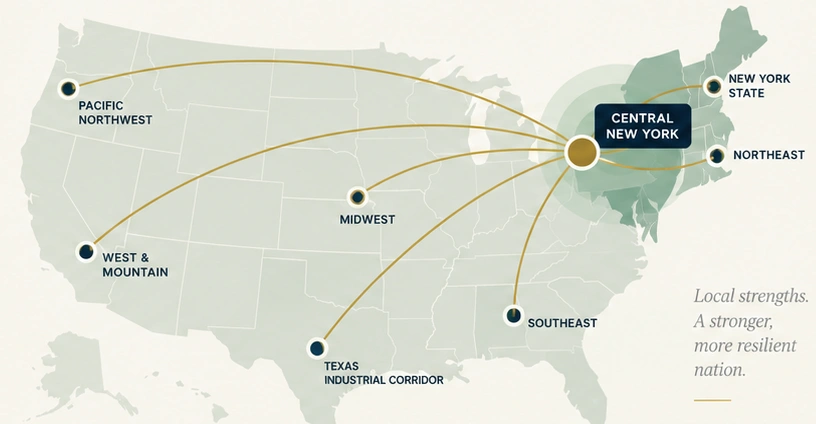
FROM CNY TO OTHER REGIONS
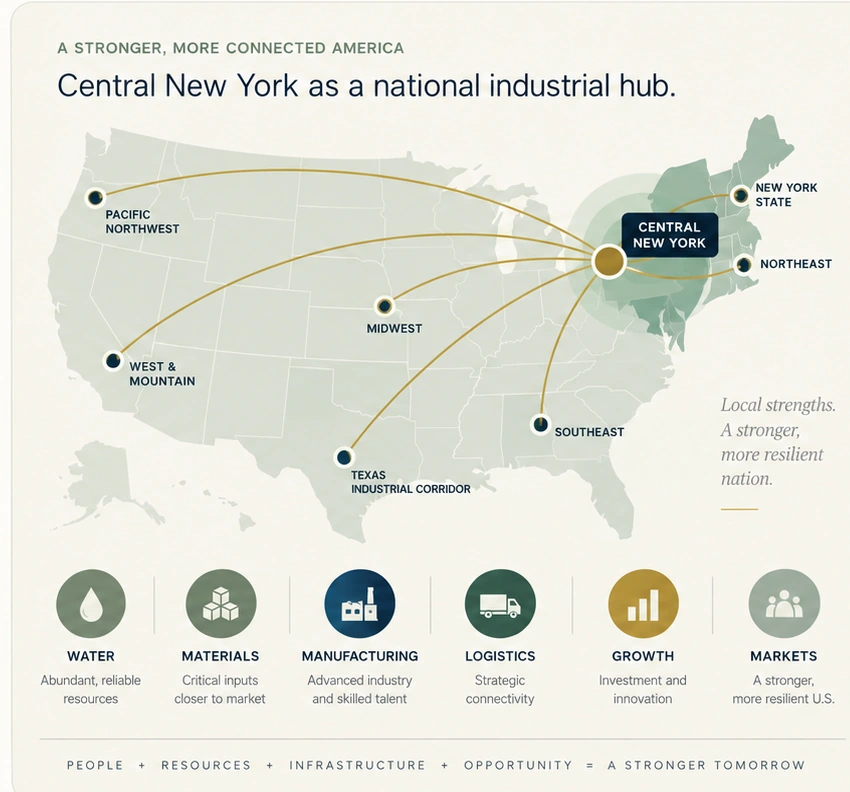
The map names places where a comparable method might be useful. It does not prescribe facilities, suggest that resources should move across the country, or establish existing commercial relationships.
Each region would begin with its own resources, technical needs, workers, regulators, businesses and buyers. The reusable asset is the way opportunities are assessed and qualified.
See the transferable methodThe V2 map also labels New York State adjacent to the CNY hub. These regional possibilities are not a ranked rollout plan or evidence of demand.
REPEAT THE DISCIPLINE, NOT THE FACILITY
Regional replication is valuable only if the decisions become more reliable. Documents, test methods, lessons and relationships can inform the next evaluation; no new region inherits approval automatically.
Identify dependable material or water streams, existing firms, industrial demand and current alternatives.
Check composition, supply stability, contamination, logistical constraints and fit-for-purpose requirements.
Match local specifications, regulatory responsibilities, operating conditions, customers and delivered costs.
Use current operators and facilities first; add capacity only where credible repeat demand justifies it.
SIX CAPABILITIES FROM THE V2 REFERENCE
The original illustration highlights six complementary domains. Their usefulness depends on local abundance, specifications, infrastructure and customer demand—not on treating every community as identical.
CAPABILITY CAN COMPOUND
The next region could reuse the lessons of the first while preserving local decisions about technology, ownership, partners and acceptable uses.

Assess reliable supply, treatment, reuse fit and operating responsibilities.

Qualify available streams, safe applications and dependable markets.
Connect technical requirements, capable suppliers and skilled teams.
Evaluate distance, transport, volumes and delivery resilience.
Develop opportunities only when measurable benefits and economics support them.

Ground the model in qualified customers, procurement and repeat demand.
FROM POSSIBILITY TO PROOF
A model can guide comparisons, but it cannot substitute for regional facts or independent decisions. Choose a question to see the evidence that would be required.
Preserve the method and its provenance. Reassess the proposed resource, market, partners and delivery conditions wherever it is applied.
Repeat source characterization and application testing against local performance and safety requirements.
Documented material or water source, sampling, variability, technical test results and applicable standards.
A NATIONAL MODEL IS NOT A NATIONAL BUILDOUT
The most useful result may be a shared assessment method, a better supplier relationship, a qualified use or a decision not to proceed. National relevance does not depend on shipping material across state lines or replicating every facility.
Retain the tests, decisions, responsibilities and operating lessons from verified experience.
Require new supply, customer, environmental and infrastructure evidence.
Evaluate local operators, regional aggregation, partnerships or doing nothing where appropriate.