01RESOURCE
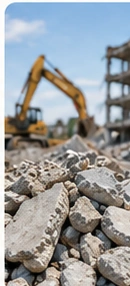
Source-separated concrete
Keep concrete apart from mixed demolition debris to limit rebar, wood, asphalt, soil and other contamination.
Pathway 02 Material characterization
Qualified recycled-aggregate applications already exist. Clean, source-separated concrete can be processed into recycled concrete aggregate (RCA) that meets specifications for a range of infrastructure and site-development uses.
The key work now is to validate actual concrete volume, contamination, stockpiling, processing, haul, and qualification economics to confirm viable, scalable supply for Central New York.
Existing applications do not establish that any particular CNY source, delivery arrangement, or planned project is already approved.
SEPARATE PROCESS
 DELIVER
From demolition to opportunity
The process begins before crushing: keep concrete separated, document its origin and inspect for contaminants. Only material meeting the relevant requirements should enter qualified uses.
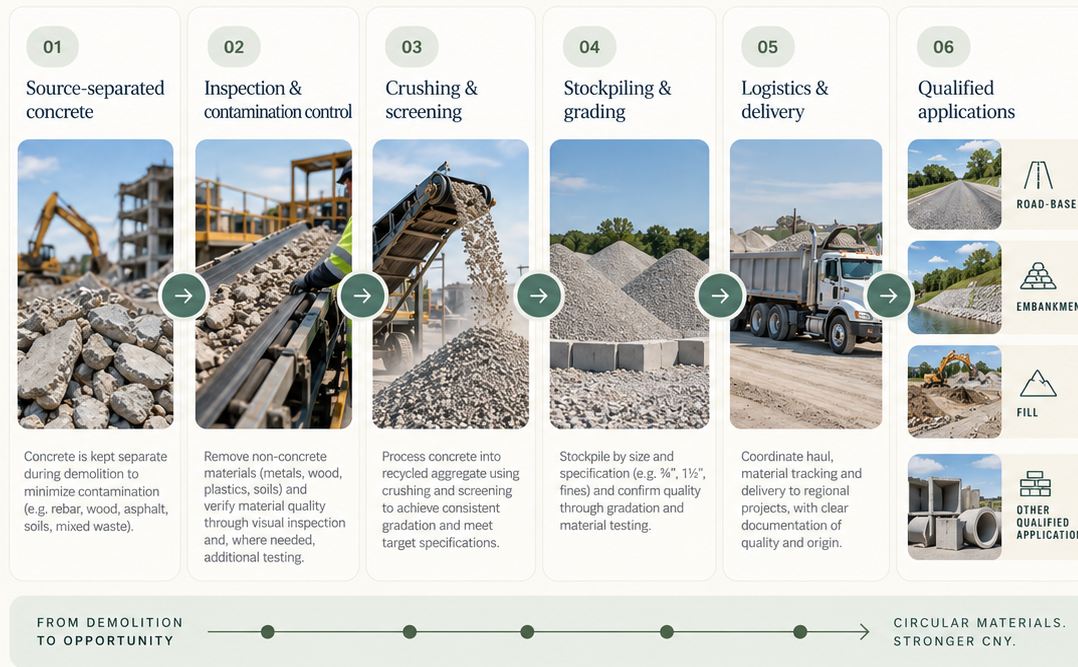
Keep concrete apart from mixed demolition debris to limit rebar, wood, asphalt, soil and other contamination.
Remove non-concrete material; document source, inspect visually, and test when appropriate.

Produce recycled aggregate with controlled particle size, gradation and quality.
Separate sizes, manage stockpiles, and confirm specified gradations by sampling and testing.
Coordinate haul distance, material handling, tracking and quality documentation for each project.
These are representative application families, not blanket approval. Every use requires the appropriate material, project and regulatory criteria.
 Road-base
 Embankment
 Fill
Fill Other qualified uses
Scroll horizontally to inspect the full original composition.
Characterize before committing
The qualification checklist is a decision tool. It does not certify any recovered material or promise a specific end market.
Location, demolition method, source separation, contamination history, quantities, variability and current disposal destination.
Evidence: source and volume recordInspection, removal of unsuitable fractions, crushing, screening, stockpile segregation, gradation and process control.
Evidence: processing and QC planAppropriate NYSDOT or project standards, gradation, compaction and durability as relevant, and environmental/regulatory suitability.
Evidence: application-specific test resultsHaul distance, throughput, yield, testing costs, delivery schedules, buyer requirements and comparison with conventional aggregate.
Evidence: supported commercial caseQualification lens
Select a participant to see the questions that would be asked during a feasibility screen. No local partnership or purchase is implied.
What projects generate source-separated concrete, what quantities exist, what contamination risks are known, and where does the material go today?
A real application is feasible only after technical, regulatory, economic and commercial fit are demonstrated for the actual source and customer.
From a stockpile to a reliable supply chain
Demolition contractors, material owners, aggregate processors, haulers, inspectors and end users each face different costs, risks and specifications. A successful local market depends on repeatable supply and purchase—not simply finding rubble.
Compare the two first pathwaysDesign source separation into demolition and site logistics before material becomes mixed waste.
Evaluate existing crushing, screening, stockpiling and lab capacity before committing to new fixed assets.
Use project-specific standards and environmental conditions; document who verifies acceptance.
Estimate delivered cost, haul radius, buyer demand, operating margins, and contracting responsibilities.
People, skills & enterprises
These are plausible occupational and small-business opportunities if regional demand is established—not forecasts or committed hires.
Site separation, equipment operation, material handling and construction logistics.
Crushing, screening, plant maintenance, repair and stockpile management.
Sampling, materials testing, safety, records, technical supervision and compliance support.
Trucking, dispatch, sales, contracting and supplier development.
Help shape what comes next
Demolition firms, civil contractors, processors, public works teams, laboratories, haulers and prospective buyers can help establish what is actually practical.
Prepare an outline about local materials, skills, demand or practical constraints. Nothing is submitted or stored by the preparation page; a receiving organization and official intake channel have not yet been established.
Prepare a contribution