01RESOURCE
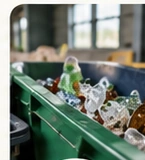
Collect & recover
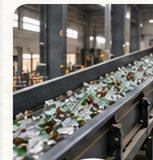
Recover glass diverted from disposal through municipal and commercial streams.
Pathway 01 Commercial validation
The material use is no longer hypothetical in Syracuse. The key question is whether a specific regional glass stream can support a durable local product pathway with commercially workable terms.
The pathway shown is a design hypothesis—not certification of a particular Central New York feedstock, product or buyer.
RECOVER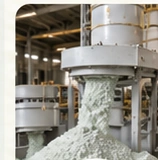 PREPARE
 QUALIFY
From local glass to stronger places
Collection alone does not create a cementitious product. Consistent sorting, cleaning, fine grinding, mix qualification and real customer demand all have to work together.
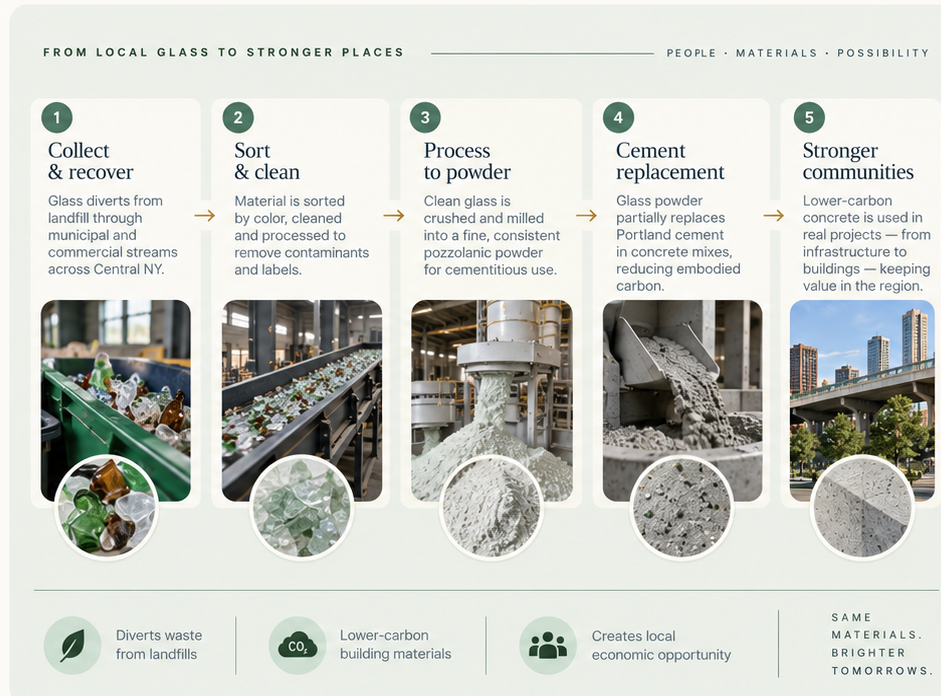
Recover glass diverted from disposal through municipal and commercial streams.
Sort by color as needed and remove labels, ceramics, metals and other contaminants.
Crush and grind sufficiently clean glass to a consistent fineness for potential cementitious use.
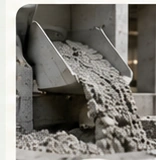
Test eligible glass powder in suitable concrete mixtures before specifying cement replacement.
Use successfully qualified concrete in appropriate projects with repeat customer demand.

Swipe horizontally if necessary to inspect the full-resolution source artwork.
Prove what works
A useful local demonstration must connect the specific source material to suitable processing, technical performance, buyer acceptance and repeatable supply.
Confirm available quantities, color/chemistry, non-glass contaminants, provenance, collection routes and seasonal variability.
Output: representative feedstock dossierEstablish processing capability, contaminant controls, fineness, yield, quality assurance and realistic energy and logistics costs.
Output: repeatable process specificationDemonstrate suitable material and concrete performance against applicable specifications, mixture conditions and customer requirements.
Output: documented performance evidenceIdentify real users, accepted products, delivered cost, procurement constraints, commercial margins and potential repeat orders.
Output: credible supplier-to-buyer pathwayQualification lens
Choose a role to see the questions that matter most. These are screening questions, not verified project outcomes.
How much glass exists, where does it move today, how consistently is it collected, and is the proposed destination better than the existing one?
Each answer requires evidence from the actual counterparties and their operating conditions.
From possibility to a working business
Glass collection, preparation, processing, concrete production and purchasing each sit with different organizations. A viable pathway must give every participant a reason to repeat the transaction.
Compare both first pathwaysInventory material streams, current outlets and aggregation potential before assuming a new plant is needed.
Test whether existing processors and equipment can serve an early qualified market.
Run representative tests, establish acceptance criteria and document the practical product boundary.
Compare delivered cost and customer confidence against established alternatives.
The compounding local opportunity
The commercial chain can support additional work if demand materializes. Roles span different experience levels; none of these opportunities should be counted as committed jobs before projects are validated.
Routing, collection, dispatch, transport and material-handling services.
Sorting, operating equipment, maintenance and production quality control.
Sampling, laboratory analysis, concrete mixtures and technical qualification.
Buyer development, contracting, supplier services and local business formation.
Help shape what comes next
Useful input can come from material owners, processors, concrete producers, laboratories, technical specialists, and prospective regional buyers.
Prepare an outline about local materials, skills, demand or practical constraints. Nothing is submitted or stored by the preparation page; a receiving organization and official intake channel have not yet been established.
Prepare a contribution